Sportsmanship and respect
Sportsmanship and respect on the fields make our beautiful sport even more fun. However, no one can do it alone. We need everyone.
Our football is from everybody
Football belongs to all of us and together we are football. If we want to make football more beautiful and better, we must all work together. So we need you too!
Football is beautiful. It connect people with each other. We cheer together and are disappointed together. The excitement and passion that comes with football is what makes the game so beautiful.
Unfortunately, there are also people wo ruin it for others. They express their tension in frustration and sometimes even violence against the referee, opponent or fellow player. Only together can we combat this behavior. So set a good example!
What happens after a foul?
Are you or an opponent committing a foul? Or is a player behaving unsportsmanlike? Then the referee can hand out a penalty kick. The more serious the violation, the more severe the punishment. The referee can give four types of penalties:
- an indirect free kick;
- a direct free kick;
- a penalty kick;
- disciplinary penalties (such as a yellow card or red card).
More about the indirect and direct free kick can be found on the pages for these game situations. More information about the penalty kick and disciplinary penalties can be found below.
When a disciplinary penalty?
The referee can give a so-called disciplinary penalty. He/ she can give the player:
- a firm warning (no card).
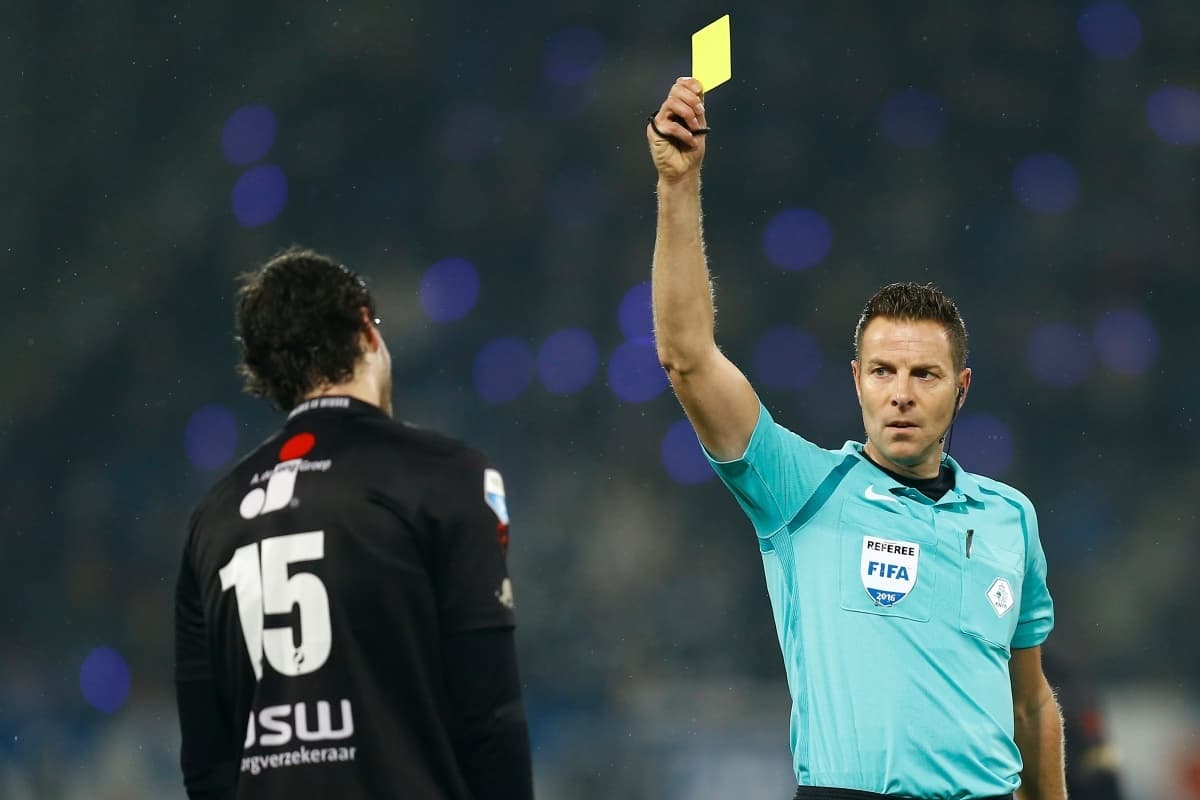
- a warning by giving a yellow card.
- send the player of the field (by giving a red card).
- After a yellow card, a registration follows (via the so-called app Digitale Wedstrijdformulier). With five registrations in five different matches, you are not allowed to play one match ("suspension"). If you receive two yellow cards in one match, you are automatically excluded from the next match.
- In matches at your level, a yellow card may also result in a time penalty. Ten minutes for seniors and juniors and five minutes for pupils. There will then be no registration. Here too, if you receive two yellow cards in one match, you are automatically excluded from the next match.
A firm warning(= no card)The referee does not give a card, but tells the player verbally (conversation) or non-verbally (gesture) that he/she must be careful and not commit that offense again.
Warning (= yellow card)
The referee punishes a player with a warning (yellow card) if he/she commits one of the following eight fouls:
- The player is guilty of unsportsmanlike behavior.
- The player shows by word or gesture that he or she does not agree with a decision of the referee.
- The player repeatedly breaks the rules of the game.
- The player delays the restart of the game.
- The player does not take the required distance at a restart.
- The player enters the field (again) without the referee's permission.
- The player deliberately leaves the field of play without the referee's permission.
- The player denies an opponent, who is moving towards the opposing team's goal, a clear scoring opportunity within his/her own penalty area (during a duel with the intention of playing the ball).
A substitute or substituted player may also receive a warning. This is possible if he/she commits one of the following three violations":
- The player is guilty of unsportsmanlike behavior.
- The player shows by word or gesture that he or she does not agree with a decision of the referee.
- The player delays the play by taking too long to restart.
Removal of the field (= red card)
The referee sends a player, substitute or substituted player off the field of play (red card) if he/she commits one of the following seven offences:
- The player is guilty of serious foul play.
- The player is guilty of a violent act.
- The player spits on an opponent or another person.
- The player denies the opposing team a goal or an obvious goal-scoring opportunity by deliberately playing the ball with his/her hands or arm (this does not apply to the goalkeeper within his or her own penalty area).
- The player denies an opponent, who is moving towards the opposing team's goal, a clear scoring opportunity outside or within his/her own penalty area by pushing, pulling, grabbing and holding.
- The player uses foul, offensive language or a swear word and/or makes gestures.
- The player receives a second warning in the same match.
It is of course impossible to describe all situations in which you commit a violation on this page. For example, are you allowed to take off your shirt after scoring a goal? No. If you do so, the referee will give you a yellow card. This unnecessarily slows down the game. So you see, not all possible violations are mentioned here. Ultimately it is the referee who decides whether a foul is committed or not and a penalty is given.
Test your knowledge and take the quiz.