Direct free kick
Which offenses require a direct free kick? When is it a penalty and when a so-called disciplinary penalty (i.e. yellow or red)? There are ten fouls that lead to a direct free kick. Kicking, pushing, hitting, holding, spitting or dropping an opponent, and making a handball are the best-known examples. If this happens in the penalty area, the referee will award a penalty.
Direct free kick
Two types of free kicks
In football, there are two types of free kicks:
- the direct free kick;
- the indirect free kick.
When is it a direct free kick?
The direct free kick is a more serious penalty. The referee awards a direct free kick to the opposing team if a player commits one of the following ten fouls:
- The player kicks or attempts to kick an opponent.
- The player trips or attempts to trip an opponent.
- the player jumps to an opponent.
- The player attacks an opponent.
- The player hits or attempts to hit an opponent.
- The player pushes an opponent.
- The player overthrows an opponent.
- The player holds an opponent.
- The player spits on an opponent.
- The player deliberately plays the ball with the hand or arm (this does not apply to the goalkeeper within his or her own penalty area), or hits the ball by throwing an object.
The referee awards a penalty to the opposing team if a player commits one of the aforementioned ten fouls in his or her own penalty area.
You may kick the direct free kick directly into your opponent's goal. This is not allowed with the indirect free kick: the ball must first have been touched by another player.
You will find more information about the indirect free kick on another page. More information about the direct free kick can be found below.
A direct free kick
You can thus kick a direct free kick directly into the opponent's goal. Furthermore, the following rules apply:
- If you take a direct free kick, you may only touch the ball a second time if it has first been touched by another player.
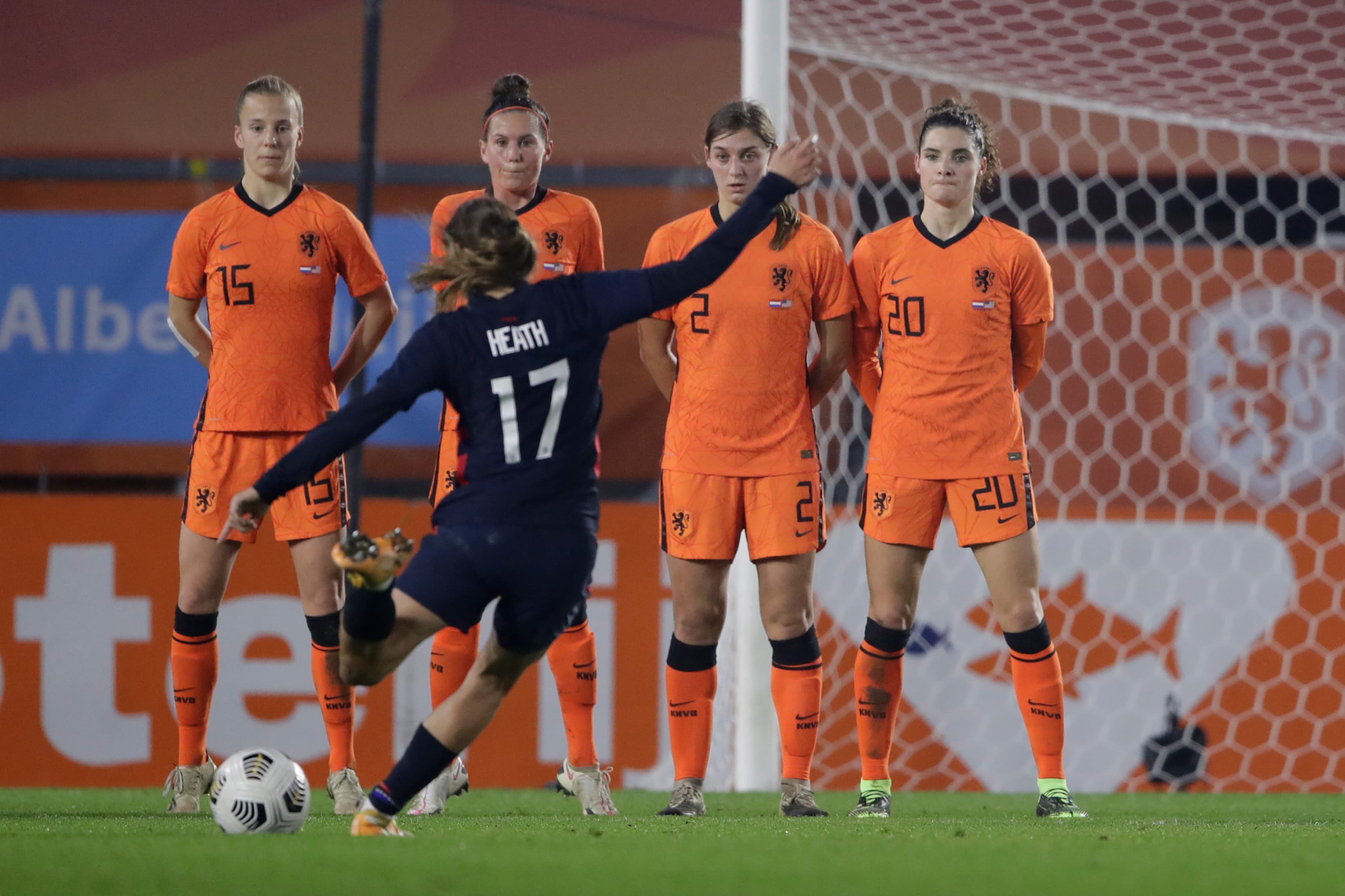
- Your opponents are at least 9.15 meter away from the ball when the free kick is taken.
- If you shoot a direct free kick into your own goal, the referee will award a corner kick to the opposing team.
During a direct free kick, the referee points with his or her arm towards the opponent's goal.
See below for some examples of the direct free kick.
A tackle with a risk
Stretched leg
The NEC player is too late in his tackle towards the ball. He hits the RODA JC player on his ankle with a straight leg. He could have seriously injured his opponent. Therefore this is a red card.
Distance to the 'wall'
During a free kick, both direct and indirect, the opponent must be at least 9.15 meters away.
When blocking
If there is 'obstruction', there is no contact with the opponent. In that case it is an indirect free kick. If there is 'blocking', there is contact with the opponent. In that case it is a direct free kick.
Take the quiz about the direct free kick below.